 A physical essay on energy, dynamics and marital misdecisions on rails
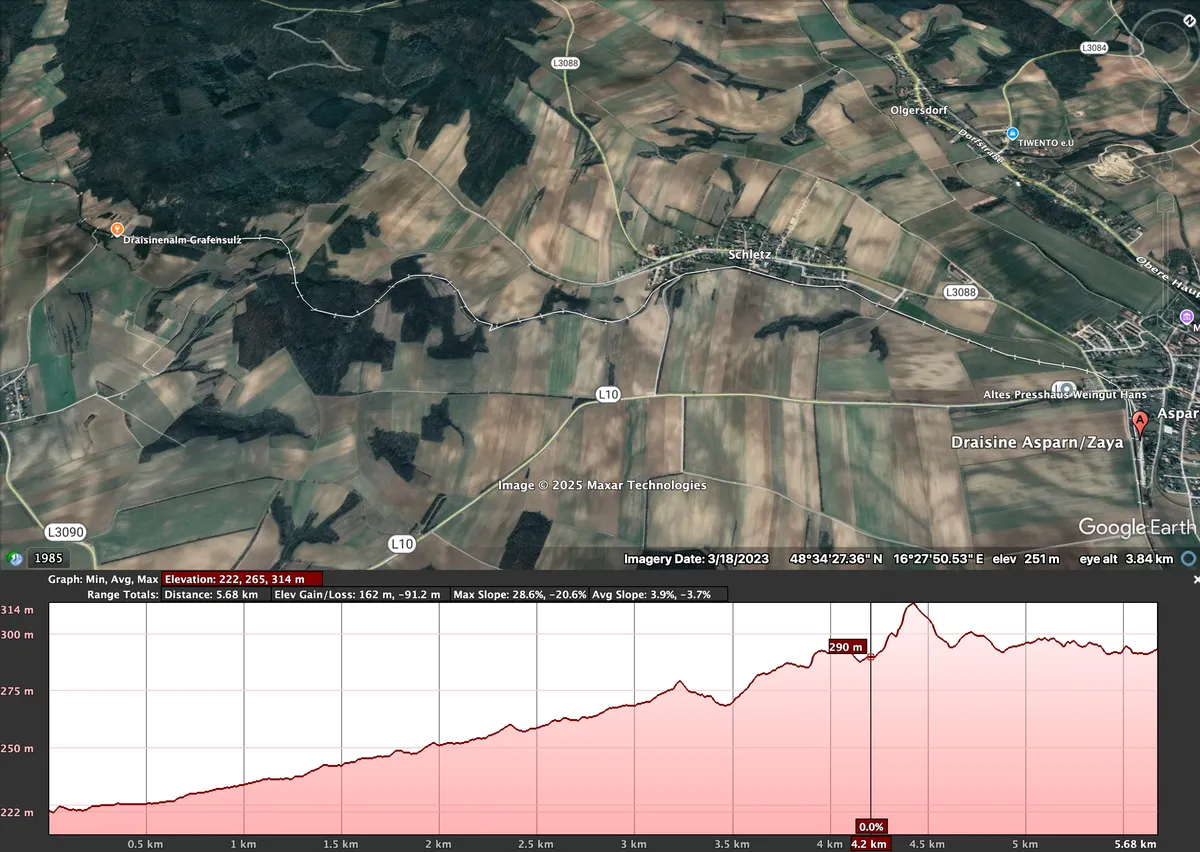
Introduction A Draisinen tour may start romantically, but often ends in reality matching with physics, incline angles and human performance. At the center of this essay is a 5.68 km long track with a height difference of 68 meters, mastered with two light rail vehicles ("draisines") and eight people on board. The physical, mathematical and interpersonal tensions culminate in the section between kilometers 3.5 and 4.5, where not only the rise but also a relationship comes to its limits.
The baseline data Total weight: 700 kg (incl. Difference in altitude: 68 mRoute length: 5.68 kmMaximum incline: approx.4.5 % in section 4.0 to 4.5 kmRoad performance:
Stephan: 300 watts
Three passengers: each with 75 watts.
Alternative scenario: four passengers, each with 75 watts.
Applied physical principles The system is based on classical mechanics. The relevant laws:
Work and Energy:Work = Force × WayPerformance = Work / Time
Pulling force
Rolling resistance: for steel on steel
Speed from performance:, where...
Mathematical implementation in the scenario The route was divided into four sections, with differentiated gradients:
Section 1 (0–1.5 km): 1.8%
Section 2 (1.5–4.0 km): 1.2%
Section 3 (4.0–4.5 km): 4.5%
Section 4 (4.5–5.68 km): 0.1%
Two scenarios were calculated.
Scenario A: With Stephan (300 W + 3×75 W = 525 W)driving time: 18:50 minEnergy consumption Stephan: 339034 JEnergy per passenger: 84.758 J
Scenario B: Excluding Stephan (4×75 W = 300 W)driving time: 32:58 minEnergy per person: 148.327 J
Conclusion of the world of numbers:Stephan allows a time saving of 14 minutes and an energy saving per passenger of over 63,000 J, i.e. about 43%. The total energy remains the same in both scenarios, but the distribution makes the difference.
The critical section: km 3.5 to 4.5 Here becomes theory practice. The steepest section requires the most energy, impulse and continuity. While even weaker drivers can keep the system moving in the flatter parts, this increase threatens to stop with too little performance. The calculations show clearly: At 300 W total power (4×75 W) the speed would be so low that momentum is lost, the system slows down itself and a restart in the slope becomes almost impossible.
The Marriage Crisis on Rails: Stephan's Uncomprehension And now to the moment when Stephan is to be replaced. His wife, with a loving look and best will, suggests that one "can also let someone else step forward." Stephan, who knows the numbers, analyzed the route and knows what is at stake, wrestles with frame.
His grant is not defiance, but rationally justified: "If I make 300 watts here, it is not out of vanity, but because it simply cannot be done without me. When you exchange me in the steepest passage for someone who brings a quarter of my performance, you don't need a calculator, but a brake screen!"
Final idea What appears to be an amusing dispute at the Bahndamm is in fact a lesson in applied physics, group logic and mutual understanding. Energy is not only measurable, but also palpable. And sometimes it's just wiser to let the one who knows how much is at stake – in life like on the Draisine.